Showing posts with label Active Directory. Show all posts

January 31, 2017

Quick Tip: Add Computer to Group – GPUpdate without Restart


Let’s say that you have a GPO that is scoped to a specific security group. If you add a computer to this security group, you would normally need to restart in order for the computer to see that it is now a member of this group. To bypass this, you can delete the system’s Kerberos ticket and run GPUpdate. The computer will magically see its new group membership without a restart.


Source : DeployHappiness | Quick Tip: Add Computer to Group – GPUpdate without Restart

November 30, 2016

Test Active Directory replication with PowerShell


When Active Directory replication breaks, IT is in trouble. PowerShell comes with a few cmdlets that allow you to test if Active Directory replication is working properly.


Source : 4sysops

June 22, 2016

How to fix broken GPO because of MS16-072


So as many of you may know, yesterday Microsoft released a security hotfix
that changed the behavior of Group Policy. Put simply if you have a security
group filtered User Group Policy Object and you also removed the “Authenticated
Users” group from the policy it will no longer apply after you install
MS16-072.


Source : Group Policy Central

May 10, 2016

Script ADMirror PowerShell Module


A set of functions to dump OUs, Users, Groups and GPOs from one Active Directory and mirror them to another, test Active Directory. Perfect for creating a test environment.


Source : gallery.technet.microsoft.com

March 18, 2016

Previewing Server 2016 TP4: Temporary Group Memberships


Hello, Ryan Ries here again with some juicy new Active Directory hotness. Windows Server 2016 is right around the corner, and it’s bringing a ton of new features and improvements with it. Today we’re going to talk about one of the new things you’ll be seeing in Active Directory, which you might see referred to as “expiring links,” or what I like to call “temporary group memberships.”

One of the challenges that every security-conscious Active Directory administrator has faced is how to deal with contractors, vendors, temporary employees and anyone else who needs temporary access to resources within your Active Directory environment. Let’s pretend that your Information Security team wants to perform an automated vulnerability scan of all the devices on your network, and to do this, they will need a service account with Domain Administrator privileges for 5 business days. Because you are a wise AD administrator, you don’t like the idea of this service account that will be authenticating against every device on the network having Domain Administrator privileges, but the CTO of the company says that you have to give the InfoSec team what they want.

(Trust me, this stuff really happens.)


Source : Ask the Directory Services Team

February 18, 2016

Step-By-Step: Removing A Domain Controller Server Manually - Canadian IT Professionals - Site Home - TechNet Blogs


The proper way to remove a DC server in an Active Directory infrastructure is to run DCPROMO and remove it. The following video provides an example of these steps...


Source : Canadian IT Professionals

February 12, 2016

Configure Ubuntu with SAMBA and set up the domain controller - 4sysops


In the previous post, we installed Ubuntu in a VirtualBox VM. Now it’s time to install SAMBA and configure the domain controller.


Source : 4sysops

February 11, 2016

Install Ubuntu Server with the netboot.xyz


In the last post of this series, I described how to prepare your VirtualBox environment. In today’s post, I’ll show you how to install the Ubuntu server with the help of the netboot.xyz iPXE .iso.


Source : 4sysops

February 10, 2016

Set up Ubuntu as a domain controller with SAMBA on VirtualBox


If you want to run a domain controller on your network but don’t have access to a Windows Server license, you can use SAMBA, the free open-source software, and VirtualBox, the free virtualization software. We’ll describe the procedure for setting up a virtual server using VirtualBox and netboot.xyz iPXE and move on to setting up your domain controller with SAMBA.


Source : 4sysops

September 16, 2015

Active Directory migration overview – Windows Server 2003 to Windows Server 2012 R2 - 4sysops


If you have the task of performing an Active Directory migration from Windows Server 2003 to Windows Server 2012 R2, there are a number of steps that you must complete for a smooth transition.

Source : 4sysops

May 23, 2014

FREE: Bulk Password Control – Automate Active Directory user object changes

The name of the free tool Bulk Password Control is perhaps a bit misleading because the free tool enables you to automate all kinds of bulk modifications on Active Directory user objects with a fast to use GUI.

You know this popular picture of the GUI admin who clicks all day to reset user passwords after a security breach. Bulk Password Control is a nice example that proves that such tasks can be quickly done with a GUI tool without much click-click.

Source : 4sysops.com, www.wisesoft.co.uk

April 1, 2014

Virtualization-safe(r) Active Directory in VMware environments, Part 1

So, let me kick off this series in which I’ll be sharing what it feels like to virtualize and clone Active Directory Domain Controllers safely on both platforms, with a blogpost on finding out whether your virtual Domain Controllers may benefit from the VM-GenerationID on the VMware-based hypervisors and, thus, may be safely virtualized and cloned.

Source : The things that are better left unspoken

September 12, 2013

Active Directory Authentication Library 1.0 for .NET – Ready for prime time!


It is a great pleasure to be able let you know that v1 of the Active Directory Authentication Library (ADAL) for .NET has reached General Availability! You can add the library to your projects directly from Visual Studio (search for ADAL) or you can download the NuGet package directly from here


source : Active Directory Blog

May 2, 2013

Active Directory-based management of Apple iOS iDevices


Some Windows systems administrators are faced with deploying and supporting Apple iDevices running iOS. What first- and third-party options exist for these sysadmins?

Complete article : 4sysops

July 3, 2012

FREE: ADREPLSTATUS – Active Directory Replication Status Tool

ADREPLSTATUS screenshot

ADREPLSTATUS has a nice Office-like GUI with a ribbon and can replace RepMon or RepAdmin of the Windows 2000 support tools.

Source : 4sysops.com 
Download : www.microsoft.com

May 2, 2012

The Most Confusing Dialog Box in Active Directory

This breakdown of Kerberos settings and how they correspond to AD provides much-needed clarity

This ongoing need to clarify how Kerberos works and how it fails is a result of the fact that—although Kerberos remains the same—the services that use it and the ways they use it are often unique. The aspects that remain the same in each scenario, however, are what the settings in Active Directory (AD) are intended to address, and the difficult-to-interpret messages you’ll see when things fail.

Source : www.windowsitpro.com

November 10, 2011

Troubleshooting the “Network accounts are unavailable” error in Mac OS X Lion

there are serious integration problems between Apple Mac OS X 10.7 Lion and Active Directory Domain Services (AD DS). Specifically, we are seeing (a) sluggish binding between the Macs and AD; (b) super-slow domain logons; and (c) completely blocked domain logons.

Source : 4sysops.com

March 1, 2011

[OS X 10.6] CreateMobileUserAccount error 4100

If you tried to logon on a MacBook Pro (OS X) with an Active Directory account you may have seen the following error in the system.log :

createmobileaccount[4146]: MCXCCacheMCXRecordAndGraph(): [localNode createRecordWithRecordType:dsRecTypeStandard:Users name:"paradisj"] == 4100 (Unable to set value or values for dsAttrTypeStandard:Password in the record.)


First of all, many thanks to Travis J. Garrison who pointed me in the right direction.


The problem was that I had two accounts in our Active Directory with the same value for the email attribute. The logon with the first account worked fine, but I wasn’t able to logon with the second one (on the same Mac).


The DirectoryServices.Error.log gave me the identity of the first account :


T[0x0000000102281000] - CDSLocalPluginNode::AttributeValueMatchesUserAlias(), alias exists in file /var/db/dslocal/nodes/Default/users/paradisjtest.plist


I had to change the email attribute (AD) of the first account and refresh the cache (MCX_cache) of the first account :


mcxrefresh -n paradisjtest -a


After that I was able to logon with both accounts.


Question :

Why does Apple used the email and displayName attribute as an alias of an account when those two attributes are not unique in Active Directory ?


(It’s not a bug, it’s a documented feature)

December 17, 2010

How to use MDT 2010 + WDS with VirtualBox

I wanted to setup a virtual lab with a Microsoft Deployment Toolkit 2010 server and a PXE client in Virtual Box. I finally got it to work !

The main problem is that the Intel PRO/1000 network card in VirtualBox does not seems to work with PXE (I dont know why) and the PCnet-FAST adapter is not supported (by default) in Windows PE (and no driver available in x64).

My solution is to simply define 2 network adapters in your virtual machine (the PXE client) :

mdt-1

PXE will use the first adapter (PCnet-FAST) and Windows PE will use the Intel PRO/1000 because it doesn’t know about the other one (no driver).

Here’s a step-by-step guide :

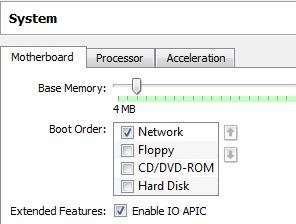
Ensure that the boot order of you VirtualBox machine allow it the boot from the Network :
mdt2b

You should also check that APIC is ON (Windows PE wont boot without it).

Boot you virtual machine, a screen like this should appear :

MDT-3

Open your "Windows Deployment Services” (WDS) console and approve the new pending device :

mdt-4

To avoid confusion in Microsoft Deployment Toolkit (MDT) I prefer to use the Computer UID instead of the MAC address to identify the computer (because we have two network adapters). To get the Computer UID at this stage, open “Active Directory Users and Computers” and display the properties of the new Computer object that WDS created when you approved the pending device.

mdt-5

On the Remote Install tab, copy the ‘Computer’s unique ID’ without the bracelets {}.

Open the ‘Deployment Workbench’ and create a new computer in the database (Advanced Configuration)

mdt-6

Enter a description and paste the ‘Computer’s unique ID’ in the UUID field. Complete the computer configuration the match your MDT setup (Assign a role or a TaskSequenceID).

That's it, reboot your virtual machine and your deployment should start.

Note : This article does not cover all your MDT/WDS setup, you have to install and configure those by yourself before using this solution. But if you used MDT before that should not be a problem.

May 28, 2010

FREE: Blackbird auditor express – Real-time Active Directory change monitoring

Blackbird auditor express is a free and easy-to-use version of Blackbird auditor. This community version offers real-time change monitoring for organizations with basic Active Directory (AD) auditing needs.

Source : 4sysops

How to Check A WordPress Site's PHP Version (& Upgrade Compatibility)

If you notice that your WordPress hosting provider is not running PHP 7, but has it available to its users, you may want to consider making ...